
Sources for Salinas Previous Residents
The era table gives a practical order for a previous residents search. Current parcel and deed records establish the land. Directories and censuses place people at dated points. Sanborn maps show the building. Permits date work. Newspapers and probate can close a life or estate trail. Each source has a different coverage range and access channel, so a gap is not proof that a household moved.
| Source | Years it covers | Where held | What it contributes |
|---|---|---|---|
| Current recorder index | 1978 to present | Tyler web index and Recorder counter images | Grantor, grantee, document type, date, number, deeds, liens, restrictions |
| Historical recorder index | 1850 to 1977 | County historical index, bound books, and counter images | Earlier deeds and the legal chain of title |
| Polk and local directories | 1926 through 1997 issues, with gaps | John Steinbeck Library Local History and microform | Householder, address, occupation, and reverse sections where present |
| Federal census | 1850, 1860, 1870, 1880, 1900 onward through released schedules | Library microform and NARA | Household composition at census dates; 1890 is mostly destroyed |
| Building permits | Current portal; older coverage not stated online | Salinas Permit Center and city records request | Construction, alteration, applicant, contractor, owner, inspection date |
| Sanborn maps | 1886, 1892, 1900, 1913 sets | Library of Congress | Building footprint, use, materials, streets, numbers, and outbuildings |
| Historical court and probate | Probate material from 1850 and later indexes | Monterey Superior Court and Historical Society | Death, estate, heirs, and property distribution clues |
The table is deliberately mixed. The recorder follows title. The library follows people and publications. The maps follow structures. A house history becomes clearer when those trails meet at the same lot and date.
Salinas Previous Residents: Today's APN
Do not begin a previous residents search with a historical surname if the house has changed its number or street label. Previous residents of Salinas are easier to trace when today's parcel is fixed before old names are compared. Enter today's address in the Monterey County Parcel Report App, save the APN, and read the current assessor result. The APN makes the current parcel a stable anchor even when a deed uses a lot, block, tract, map book, or page instead of a street address.
Compare the physical parcel, situs address, map page, and legal description. The owner mailing address may be elsewhere. A current assessed owner is a land record clue, not proof of present occupancy. The assessor's Internet roll is APN-first because owner-name and street-address searches are not offered under the county's implementation of Government Code section 6254.21.
The Salinas street directory explains the current address-to-APN sequence. Once the APN is fixed, the backward trail can use the recorder without treating a street label as a deed index key.
Salinas Deed Chain for Past Residents
The Monterey recorder index splits at 1978. Current records are in the Tyler index, while the historical index reaches from 1850 through 1977. Search the present assessed owner as grantee to find an acquisition instrument. Confirm the APN or legal description, record the seller as grantor, and search that seller as grantee for the prior acquisition. Continue until the index or bound book stops.
- Save the current APN, legal description, assessed owner, and parcel map context.
- Search the owner as grantee and compare document number, recording date, deed type, and land description.
- Write down the grantor and repeat the grantee search for the earlier transfer.
- Move from the current Tyler index to the historical 1850 through 1977 index when the date crosses the cutoff.
- Order an image or copy when the wording, map reference, or party role matters.
- Grantor
- The party transferring or granting an interest in the recorded instrument.
- Grantee
- The party receiving the interest named in the instrument.
- Chain of title
- The linked sequence of transfers used to follow an interest in land backward.
- Legal description
- The land description that controls the deed even when the street number changes.
The index is like a library card catalog. Search spelling variants, initials, and both party roles. A document image at the Recorder terminal or an official copy is needed when an index line cannot settle the match.
Salinas Previous Residents: Directories and Census Dates
Directory years and census years rarely align perfectly, which is why a past household should be described as a time point. A Polk listing can supply an address and occupation, while a nearby census can show household composition. The 1890 federal census gap makes the 1890 Great Register, the library's directories, hospital census, and newspaper abstracts especially useful substitutes.
Start with the directory entry and copy its exact wording. Check the nearest census year, then test the address against a deed, map, or newspaper. If a spouse name changes, an occupation shifts, or a new household appears, mark the change rather than smoothing it into one continuous story.
The Salinas city directory collections page covers the library shelf and the reverse sections that can turn an old address into a named household.
Past Salinas Residents: Sanborn Years and Houses
Salinas Sanborn sheets from 1886, 1892, 1900, and 1913 can show whether a structure, rear dwelling, outbuilding, street number, or building use changed across the directory eras. They do not name the people inside. Their value comes from comparison with a directory, deed, or permit that does.
A map can explain a break in an address trail. A rear dwelling may have its own listing. A changed footprint can show that the same lot carried a new structure. A street number can look different while the lot and block remain stable. Verify the map edition and sheet before drawing a conclusion.
No authoritative Salinas street-renumbering year was established in the research. Sanborns and parcel maps should be used to test continuity, not to invent a date.
Salinas Past Residents and Permit Dates
Building and planning records can add a construction date to the previous residents trail. Salinas Paperless Permits supports current applications for building, demolition, reroof, single-trade work, signs, solar, and revisions. It is account-oriented, with email and password login, and does not present a complete public historical index of every address.
For older permit cards, plans, inspection history, or City Reports, ask the Permit Center or use the city Public Records route. An applicant, contractor, or owner named on a permit identifies a project participant. It does not establish who lived at the address during the work.
The Salinas Paperless Permits portal shows the account entry point.
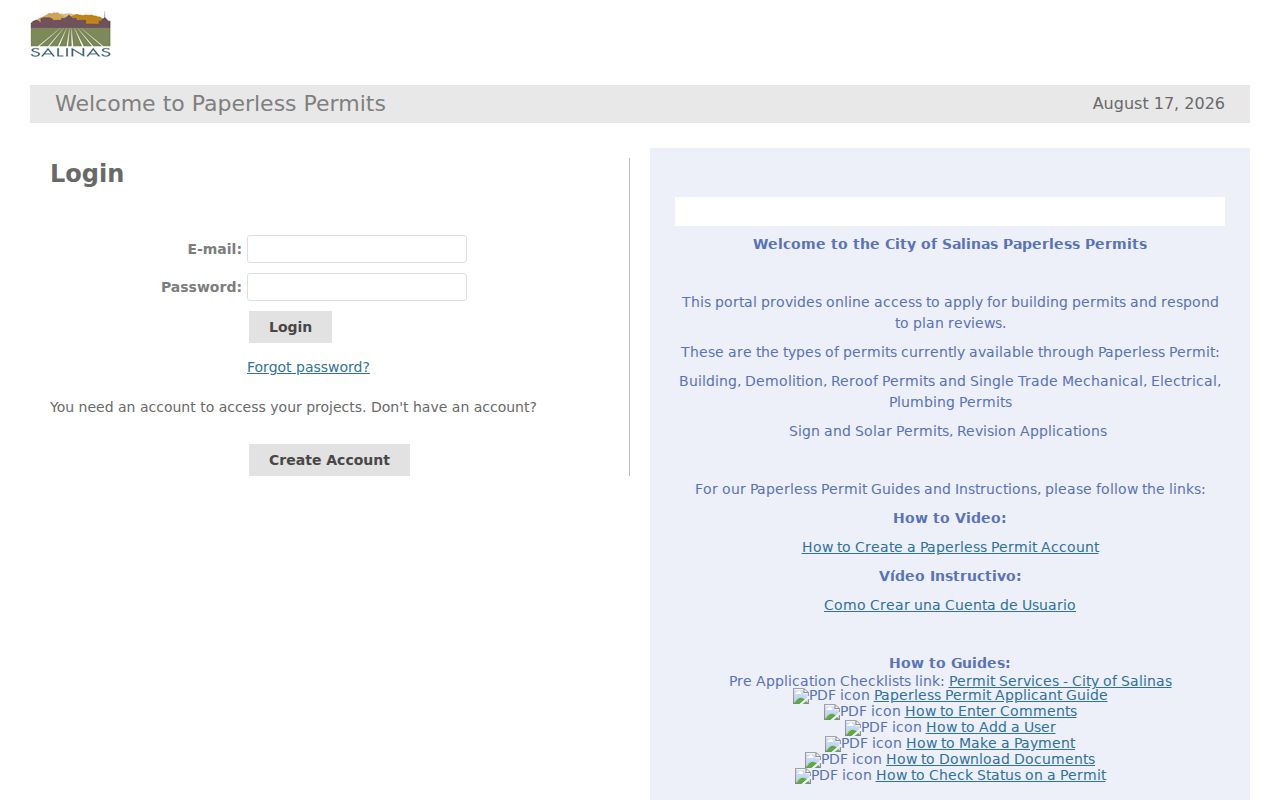
The portal is useful for a project trail when the account holder has access. City staff and a focused records request remain the fallback for older releasable files.
Salinas Previous Residents and Probate
Probate and obituary records can close a previous residents search when a household member died or left an estate. Start with a dated newspaper notice, California Death Index entry, cemetery transcription, or death certificate. Then search the Monterey court probate route for a decedent, petition, estate, or notice. A probate file may identify heirs or interested persons, but it remains subject to court access and confidentiality rules.
The Monterey County Historical Society's vault adds older county assessment, deed, Great Register, court, probate, lot, and burial material. Its archival holdings include early county records and private collections that can bridge a gap between a directory and a land transfer. Research is by appointment.
The court's civil, family, and probate records page explains the public access route.
A probate result is evidence of an estate or court event. It should be paired with the deed and address trail before it is used to describe a past household.
Past Salinas Residents on Rural Routes
Salinas address history is shaped by growth. The first annexation brought 52 acres along Romie Lane in 1933. Forty-three additions from 1950 through 1956 doubled the city area. Alisal rejected annexation in 1949 and joined East Salinas in 1963, when the city's population nearly doubled to about 50,000. Later growth reached Harden Ranch, Creekbridge, Williams Ranch, and Northridge.
Polk volumes also include rural routes and valley communities. A former resident can appear under a township, route, or nearby community before an address carries a Salinas postal city. Preserve the old locality. Use the 1878 grade map, Sanborn sheets, deeds, and parcel maps to test whether the land is continuous.
A change in city label is not by itself evidence of a change in household. The map and legal description should do that work.
Salinas Previous Residents and Newspaper Gaps
Newspapers can connect directory issues with births, marriages, deaths, naturalizations, reunions, property notices, and estate events. The John Steinbeck Library has Salinas Weekly Index and Salinas Californian material, including abstracts from 1873 through 1882 and extensive microfilm. A title-continuation chart helps keep a search from stopping when the newspaper name changes.
Use the printed date, page, and name spelling. A notice may name a relative, executor, or address without proving that every person listed lived there. Pair the notice with the directory, deed, census, or probate source.
The historical newspaper chart shows how the local run changes over time.
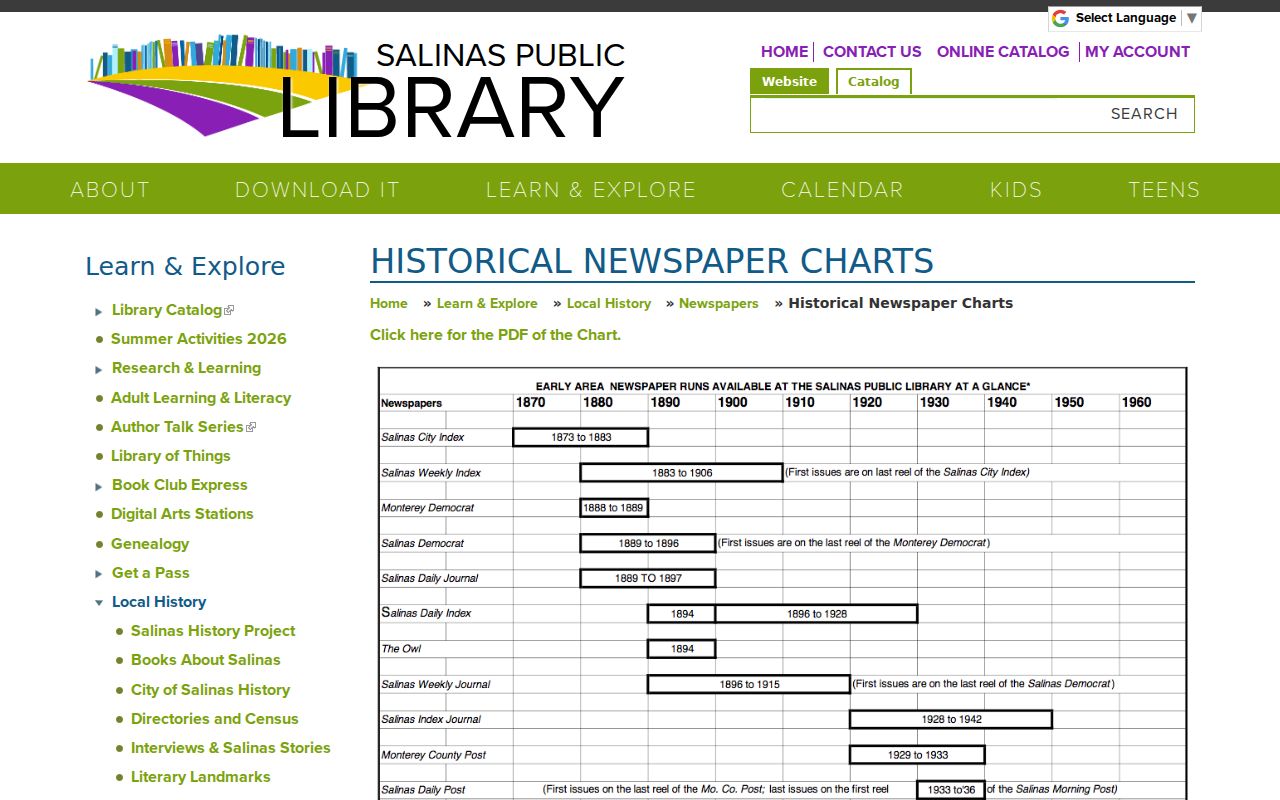
The chart is a research aid for finding the right title and date range. The article or abstract remains the evidence for a person or event.
Past Salinas Residents, Households, and Limits
Previous residents are historical evidence, not a present household list. Previous residents remain tied to their source year, even when several records point to the same address. A directory captures a publication year. A census captures a census date. A deed records parties to land. A permit dates work. A probate file follows an estate. The strongest house history states exactly which source supports each part.
Commercial profile pages may merge names, repeat old addresses, or omit the record date. Official county, court, library, and archival sources are slower, but their custodians and access limits can be checked. If an online trail ends, use the Recorder counter, courthouse public computer, library Reference Desk, Historical Society appointment, or focused records request.
Lawful house history. Use a past-residents search for genealogy, property history, estate research, or respectful local history. Never use an old address to stalk, harass, threaten, impersonate, or expose a protected person.
Stop when a record is sealed, confidential, protected by Safe at Home, or not releasable. A clean gap is more accurate than a guessed household.